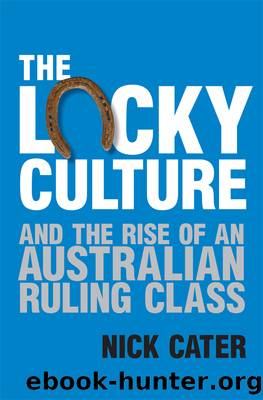
The Lucky Culture by Nick Cater
Author:Nick Cater
Language: eng
Format: epub
Publisher: HarperCollins Publishers
Published: 2013-09-14T16:00:00+00:00
I don’t look at a person – the colour of their skin or their cultural background. What I’m interested in is, are you Australian? Do you love this country as much as I do? Would you stand up and fight for it? Do you want the same values and way of life that I want, you know? … And all I ask of people is come here, respect our country, respect our laws, our culture, our way of life. Be Australian, join us, enjoy this beautiful country and everything that it has to offer.
Like Calwell, who Hanson referred to in her maiden speech, the case for the defence is made harder because she offended the rules of civilised debate. Her claim that Australia is being ‘swamped by Asians’ who ‘form ghettos and do not assimilate’ is not easily overlooked. Hanson’s limited outlook was summarised by Paul Kelly as ‘a manipulation of grievance, exploitation of rural resentment, funny-money quackery and racism’. Hansonism provided a rich vein for those ever on the lookout for the dark, racist stain they believe lurks beneath the veneer of Australian civilisation.
The significance of Hanson’s One Nation movement was not to be found in the little it brought to the debate, but in the counterpoint she offered to the prevailing wisdom. Hanson threw the dominant agenda into stark relief, pricking its moral vanity and drawing out its illiberal tendencies. There was some truth to her accusation that a self-appointed elite, without a legitimate mandate, had stolen the agenda and denied middle Australia any say on the socially disruptive issue of multiculturalism. ‘For far too long ordinary Australians have been kept out of any debate by the major parties,’ she said. ‘I and most Australians want our immigration policy radically reviewed and that of multiculturalism abolished.’
The reaction of the so-called elite to the challenge of Hansonism is instructive: first it tried to ignore her, fearing that the oxygen of publicity might increase her potency. Then they attempted to belittle her, mocking her ignorance, her unsophisticated manner, her accent and occupation. Hanson was positioned at the extreme end of a dubious political spectrum that placed Labor close to the centre, the Coalition some way to the right, and Hansonism somewhere between John Howard and fascism. It was nonsense, of course, serving only to illustrate the prejudices of the political class and the inadequacy of the conventional linear model as a guide to the Australian political landscape. Historically, social conservatism, the primary element of Hansonism, had a close association with Labor and its working-class base. Indeed, Hanson would not have been elected without the votes of thousands of working-class constituents who, until 1996, had been rusted on to Labor. It was not, as the progressives tried to pretend, an outbreak of right-wing extremism, but further evidence that the attachment between the workers and the workers’ party was weakening, and that Labor’s base was restless. Heavy losses in outer suburban seats once considered safe for Labor had cost the party the
Download
This site does not store any files on its server. We only index and link to content provided by other sites. Please contact the content providers to delete copyright contents if any and email us, we'll remove relevant links or contents immediately.
| Anthropology | Archaeology |
| Philosophy | Politics & Government |
| Social Sciences | Sociology |
| Women's Studies |
Cecilia; Or, Memoirs of an Heiress — Volume 1 by Fanny Burney(32558)
The Great Music City by Andrea Baker(32018)
Cecilia; Or, Memoirs of an Heiress — Volume 2 by Fanny Burney(31956)
Cecilia; Or, Memoirs of an Heiress — Volume 3 by Fanny Burney(31941)
We're Going to Need More Wine by Gabrielle Union(19046)
All the Missing Girls by Megan Miranda(16023)
Pimp by Iceberg Slim(14506)
For the Love of Europe by Rick Steves(14121)
Bombshells: Glamour Girls of a Lifetime by Sullivan Steve(14073)
Talking to Strangers by Malcolm Gladwell(13370)
Norse Mythology by Gaiman Neil(13363)
Fifty Shades Freed by E L James(13239)
Mindhunter: Inside the FBI's Elite Serial Crime Unit by John E. Douglas & Mark Olshaker(9339)
Crazy Rich Asians by Kevin Kwan(9290)
The Lost Art of Listening by Michael P. Nichols(7506)
Enlightenment Now: The Case for Reason, Science, Humanism, and Progress by Steven Pinker(7311)
The Four Agreements by Don Miguel Ruiz(6763)
Bad Blood by John Carreyrou(6621)
Weapons of Math Destruction by Cathy O'Neil(6279)
